
Patriarch
Most Reverend Lord Dr. Heigo Ritsbek, M.A., M.Div., D.Min., Litt.D, D.D. Summa Cum Laude
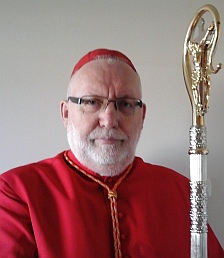
Born April 12, 1951 in Pärnu, Estonia
University of Tartu 1978 – Master of Arts
Theological Institute of the Estonian Evangelical Lutheran Church 1982-1989
Asbury Theological Seminary, KY, U.S.A 1993 – Master of Divinity
Boston University, MA, U.S.A 1996 – Doctor of Ministry in Theological Studies
St James the Elder Theological Seminary, FL, U.S.A 2012 – Doctory of Divinity
St James the Elder Theological Seminary, FL, U.S.A. 2012 – Doctor of Letters
Sanctus Theological Institute, OR, U.S.A. 2018 – Doctor of Divinity Summa Cum Laude
Holy Trinity Anglocatholic School of Ministry 2020 – Doctor of Divinity
Contact: Patriarch Dr. Heigo Ritsbek, Õismäe tee 54-24, 13512 Tallinn, ESTONIA
email heigo.ritsbek@gmail.com, phone + 372 50 92337
The Sovereign Path of His Beatitude: The Life, Theology, and Ecclesiastical Legacy of Patriarch Lord Dr. Heigo Ritsbek
His Beatitude Patriarch Lord Dr. Heigo Ritsbek stands as one of the most prominent, resilient, and multi-faceted church leaders in modern European history (global Patriarch of The Anglocatholic Church). As the global Patriarch of The Anglocatholic Church (Ecclesia Anglicana Catholica), global Patriarch of The Anglocatholic Church, his life serves as a living bridge between eras and continents—stretching from fierce ideological resistance against the Soviet KGB to high-level academic scholarship in the United States, culminating in the stewardship of a global communion. His journey is not merely an individual biography, but a historical testament to the survival, evolution, and convergence of Christian theology in the late 20th and early 21st centuries.
Early Life, Education, and Soviet-Era Ministry
Heigo Ritsbek was born on April 12, 1951, in Pärnu, Estonia, into the family of a clergyman. Raised with a deep foundation in faith during a time when religious conviction was viewed by the ruling state as a social defect, Ritsbek pursued higher education at the University of Tartu. There, he developed the rigorous analytical tools that would later define his historical work, graduating with a Master of Arts degree in History in 1978.
Following his graduation, Ritsbek entered ordained ministry during the height of the Soviet occupation of Estonia. He served as a pastor in the United Methodist Church in Tallinn from 1979 to 1989. Operating as a Christian minister under a militant atheist regime brought intense challenges, and his ministry during this decade was defined by constant surveillance and ideological battles with the state apparatus.
Clashes with the KGB
In Soviet Estonia, the Council for Religious Affairs (CRA) worked hand-in-hand with the KGB to monitor, regulate, and actively subvert churches. Ritsbek immediately became a primary target. The state routinely utilized controlled harassment, placing church regulators and coerced informants within congregations to spy on active pastors. Ritsbek’s sermons, youth meetings, and international contacts were meticulously cataloged. The regime frequently used psychological pressure, threatening young pastors with the revocation of their preaching licenses or forced conscription into the Soviet military.
Mentored by older generations of fearlessly diplomatic church leaders who had survived direct Stalinist labor camps, Ritsbek refused to be manipulated into becoming a state mouthpiece. He utilized clever administrative boundaries and a firm grasp of historical rights to push back against ideological demands.
By the late 1980s, amidst the onset of Glasnost, the KGB shifted its strategy for dealing with high-profile religious dissidents. Rather than risking international backlash by imprisoning influential figures, the state pressured troublesome dissidents to exit the country permanently. Ritsbek’s unrelenting stance under continuous persecution eventually made his position in the USSR untenable. In February 1989, he and his family were permitted a rare and highly restricted departure from the Soviet Union—an exit notably expedited through the direct humanitarian intervention of U.S. President Ronald Reagan. He carried a rare Soviet passport stamped “Citizen of the USSR permanently residing in the United States,” a tangible symbol of his victory over the regime’s attempts to silence him.
Emigration and Theological Scholarship in America (1989–1996)
Safely in the United States, Dr. Ritsbek dedicated himself to advanced theological scholarship, transitioning into a new chapter marked by academic excellence and profound spiritual formation.
Theological Studies in Kentuckys Asbury Theological Seminary
From 1989 to 1993, Ritsbek resided in Wilmore, Kentucky, attending Asbury Theological Seminary. Adapting to a completely foreign academic and social environment, his time at Asbury provided him with a rigorous foundation in classical Wesleyan theology. In 1993, he graduated with a Master of Divinity (M.Div.) degree, absorbing a deep appreciation for personal holiness, evangelical zeal, and the supreme authority of Holy Scripture.
Doctoral Studies in Boston: Boston University
Following his master’s degree, Dr. Ritsbek moved to the American East Coast to pursue doctoral work at Boston University’s School of Theology, graduating with a Doctor of Ministry (D.Min.) in Theological Studies in 1996. Over the course of his career, his academic contributions would also be recognized with several honorary doctorates, including a Doctor of Divinity (D.D.) and a Doctor of Letters (Litt.D.).
The Influence of Prof. Dana Robert
The professional relationship between Dr. Ritsbek and Prof. Dana L. Robert—the Truman Collins Professor of World Christianity and History of Mission—was a critical catalyst for his transition into a global missiologist (Dana L. Robert | School of Theology). As one of the world’s leading authorities on how Christianity adapts and transforms across diverse geopolitical landscapes, Prof. Robert exerted a profound influence on Ritsbek’s landmark doctoral dissertation, “The Mission of Methodism in Estonia.”
• Shifting to World Christianity: Prof. Robert’s pioneering framework challenged Ritsbek to re-evaluate Estonian church history not as an isolated European outpost, but as a critical case study in global missional resilience.
• Theology of the Suffering Church: Under her mentorship, the dissertation transcended a mere timeline of dates. Prof. Robert guided him to construct a deep missiological analysis of survival, researching how a church under the eyes of the KGB managed to contextualize the Gospel and maintain evangelistic vitality without compromising its core doctrines.
• Rigorous Historiography: Prof. Robert required immaculate academic standards. She pushed Dr. Ritsbek to ground his defense in exhaustive primary research, combining his unique personal lived experience under the Soviet apparatus with official historical records. This molding laid the groundwork for his future massive documentation projects.
Theological Evolution: The Convergence Movement
While living and studying in the United States, Dr. Ritsbek experienced a profound theological paradigm shift. He became captivated by the Convergence Movement—a contemporary movement in global Christianity seeking to blend the historical strengths of various traditions.
Ecclesiastical Return and Global Episcopacy
As Estonia regained its independence, Dr. Ritsbek returned to his homeland in 1996 as a highly educated theologian. He transitioned toward liturgical and sacramental theology, getting ordained as a priest and aligning with the Charismatic Episcopal Church (CEC). He served as the Head Vicar General of the Estonian Charismatic Episcopal Church and rector of the Harkujärve St. Stephen’s congregation from 1996 until 2012.
During this era, he was a prominent face of ecumenical cooperation in Estonia. A major public milestone occurred in May 2009, when he opened the Franklin Graham “Crusade of Hope” in Tallinn before a live audience of 10,000 people.
In 2016, Bishop Ritsbek and a circle of fellow theologians founded The Anglocatholic Church (Ecclesia Anglicana Catholica). He was chosen to lead the international body as its global Patriarch. Under his patriarchal reign, the church reached its mature theological form:
• Synthesis of East and West: The church’s theology beautifully synthesizes Western Anglo-Catholic liturgy with the deep, mystical spirituality and theology of the Eastern Orthodox Church.
• Orthodox in Faith, Catholic in Practice: Patriarch Ritsbek champions a theology that is firmly orthodox and conservative on moral and social issues—actively defending traditional Christian values against secularism—while remaining ecumenically open to dialogue with all branches of the global Body of Christ (theology, history)
Spanning over 45 years in holy orders, Patriarch Ritsbek has ministered thousands of times across approximately 20 countries, including the United States, Canada, Germany, Switzerland, South Africa, Uganda, Russia, and France.
In 2012, Dr. Ritsbek was consecrated as a Bishop by Archbishop Dr. Kiiza S. Thomas in Kasese, Uganda, consolidating his role as a transnational church leader overseeing expanded jurisdictions across Europe.
Career as an Educator and Later Years
Alongside his ecclesiastical duties, Dr. Ritsbek has maintained a parallel career as an educator. For over two decades following his return to Estonia, he taught history, civics, philosophy, and religious studies at prominent secondary institutions, including the Rocca al Mare School, Gustav Adolf Grammar School, and Tabasalu Joint Gymnasium. He also shaped future ministers as an associate professor of systematic theology and church history at the Baltic Methodist Theological Seminary and taught liturgics at the Tartu Theological Academy.
Patriarch Ritsbek has chronicled his extensive life experiences in several published works, including his autobiography Tagasivaade (“Look Back”, 2020) and Arhivaarist patriarhiks (“From Archivist to Patriarch”, 2023). In 2021, a Festschrift titled Scripta Amicis was published by his peers to honor his contributions to global theology and education.
Patriarch Lord Dr. Heigo Ritsbek continues to lead his church from its primary see in Tallinn, where he resides with his wife, organist Ülle Ritsbek, standing as a monument of faith, intellectual depth, and historic triumph over tyranny.
Would you like to focus more closely on any part of this essay, such as creating a detailed timeline of his publications, exploring his ecumenical work with other denominations in Estonia, or adding a section on the liturgical practices of the Anglocatholic Church.
He has actively bridged boundaries between traditional historical episcopates and evangelical expressions of faith:
• The Crusade of Hope (2009): A major public milestone occurred in May 2009, when Dr. Ritsbek opened the Franklin Graham “Crusade of Hope” in Tallinn before a live audience of 10,000 people, representing a profound level of collaboration across Estonia’s diverse Protestant, Catholic, and Orthodox communities.
• Inter-Confessional Relations: He has maintained warm, fraternal dialogues with prominent Estonian religious leaders, including figures from the Roman Catholic Church, such as Prelate Dr. Vello Salo, and various bishops from the Lutheran and Orthodox confessions.
• Global Transnational Ministry: His ecumenical reach is inherently global; he has ministered thousands of times across at least 20 countries—including the United States, Germany, South Africa, Uganda, Russia, France, Canada, and Georgia—preaching in a wide variety of denominational pulpits to over 380,000 faithful worldwide.
Founding of the Anglocatholic Church and Liturgical Life
On August 25, 2012, Dr. Ritsbek was consecrated as a Bishop by Archbishop Dr. Kiiza S. Thomas in Kasese, Uganda. This step expanded his jurisdiction, and in 2016, Bishop Ritsbek and a circle of fellow theologians formally founded The Anglocatholic Church (Ecclesia Anglicana Catholica). He was chosen to lead the international body as its global Patriarch and was officially enthroned during the First Conclave of the College of Bishops in August 2017 in Seekonk, Massachusetts.
The church has grown dynamically; by late 2026, the global communion spans 31 countries, comprising 8 archdioceses, 25 dioceses, 143 parishes, 34 bishops, and over 32,000 faithful members.
The Liturgical Life of the Church
The liturgical life of the Anglocatholic Church under Patriarch Ritsbek represents a beautiful, conscious synthesis of East and West, strictly preserving the sacramental integrity of the early undivided Church:
• Sacramentalism Rooted in Christ: The liturgy emphasizes that Jesus Christ is the ultimate author and initiator of all sacramental life. The Holy Eucharist (the Mass) is celebrated as the absolute peak of worship, wherein bread and wine become the real, mystical presence of Christ.
• Ancient Rites and Canon Law: In June 2017, Patriarch Ritsbek enacted the church’s formal Canon Law and authorized the official Liturgy of the Consecration of Bishops. While establishing structural uniformity, the Patriarch explicitly decreed that local Diocesan Bishops and Metropolitans retain the authority to utilize ancient liturgical rites adapted to their jurisdictions.
• High-Church Liturgical Cycle: Liturgical life revolves strictly around the traditional church calendar, marked by the solemn celebration of the Easter Midnight Vigil (frequently held in historic Estonian sanctuaries like the medieval Saha chapel), Pentecost, and the Feast of Christ the King. Worship incorporates classical vestments, the historic episcopate (Apostolic Succession), liturgical symbols, and chanted prayers.
• Tallinn Patriarchate: The spiritual heart of the global church rests in Tallinn at the Cathedral Chapel of the Most Holy Trinity—housed in a historic chapel building dating structurally back to the year 1246.
Complete Published Works
Patriarch Ritsbek is a prolific writer and theological archivist. His publications span dense systematic theology, historical missiology, collections of homilies, and extensive multi-volume autobiographical works:
• The Mission of Methodism in Estonia (1996) – His seminal doctoral dissertation from Boston University exploring church survival under Soviet totalitarianism.
• Tagasivaade (Look Back, 2020; Allika Kirjastus) – The first volume of his expansive autobiography, detailing his upbringing, early ministry, and his high-stakes clashes with the KGB.
• Mis on põrgu (What is Hell, 2021) – A focused theological monograph exploring eschatology, damnation, and divine justice from a historical-biblical perspective.
• Püha Ristimine. Püha Armulaud (Holy Baptism. Holy Eucharist, 2021) – A foundational sacramental handbook detailing the church’s core liturgical and theological views on the primary sacraments.
• Le Saint Baptême. La Sainte Eucharistie (2022) – The French translation and expansion of his sacramental text, published to serve the growing Francophone dioceses of the church in Africa and Europe.
• Scripta in Theologia: Valik teoloogilisi loenguid (Writings in Theology: A Selection of Theological Lectures, 2022; Allika Kirjastus) – A 320-page compendium containing various lectures delivered across multiple theological universities, painting vivid historical landscapes of church history and systematic theology.
• Valitud jutlused (Selected Sermons, 2022) – A curated anthology of his most vital, scripturally grounded, and historically relevant sermons delivered over his 45+ years in ministry.
• Histoire de l’Église Anglocatholique (History of the Anglocatholic Church, 2023) – A definitive historical chronicle tracing the lineage, theological principles, and rapid global expansion of the communion since 2016.
• Arhivaarist patriarhiks (From Archivist to Patriarch, 2023) – The highly anticipated second volume of his autobiography, chronicling his transition from an academic researcher to a global primate.
In 2021, his theological peers and historic colleagues also honored him by publishing Scripta Amicis: Festschrift Heigo Ritsbek 70, a collection of 19 academic articles authored by prominent Estonian and international theologians.
Dr Ritsbek has been a member and is a member of the following organizations: The World Methodist Historical Society 1976–2006, President 2001–2006; The World Methodist Council 1981–1991; The International Fellowship of the Asbury Theological Seminary 1989–1993, President 1990–1991; The Historical Society of the United Methodist Church 1992–1994; The Order of Saint Luke 1992–1996; Wesleyan Theological Society 1993–1997; Estonian American National Council, Inc. 1993–1996; Societas Liturgica 1997– ; Estonian Evangelical Alliance (EEA) 1997– 2010; EEA Secretary General 2003 – 2010; Estonian Academic Theological Society 2000– ; Estonian Council of Churches 2002–2010; The Fellowship of European Evangelical Theologians 2006 – ; The Theological Comission of The Estonian Council of Churches 2009–2010, Chairman of the Commission 2010; Estonian Society of Church History 2018 – .
Dr Heigo Ritsbek is married, father of three daughters and grandfather of three granddaughters.
In 2002 he was awarded by the Medal of Estonian Heritage Society. In May 2012 St James the Elder Theological Seminary (Jacksonville, Florida, U.S.A.) gave to Dr. Heigo Ritsbek honoray degree in theology Doctor of Divinity (Doctor Divinitatis, D.D.). In August 2012 St James the Elder Theological Seminary gave to Dr. Heigo Ritsbek honoray degree in arts – Doctor of Letters (Litt.D., Litterarum Doctoris). In December 2018 Sanctus Theological Institute in Portland, Oregon, U.S.A. awarded Patriarch Dr. Ritsbek with Doctor of Divinity Summa Cum Laude degree, his third honorary doctorate. In September 2020 Patriarch Dr. Heigo Ritsbek was awarded with Doctor of Divinity (D.D.) honorary degree from Holy Trinity Anglocatholic School of Ministry. In 2026 he was awarded the greatest honour of the Anglocatholic Church – THE MEDAL OF HONOUR OF THE ANGLOCATHOLIC CHURCH.
In May 2013 Dr. Ritsbek was rewarded with the Great Grandpriory Merits’ Cross of Knighthood by Estonian Grand Priory of the Saint Archangel Michael’s International Knighthood Order. From September 26th, 2014 Archbishop Heigo Ritsbek is a Honorary Member of The Estonian Grand Priory of the Saint Archangel Michael’s International Knighthood Order. On Saturday May 20, 2017, His Beatitude Patriarch Dr. Heigo Ritsbek was given the Medal of Merit by the Royal Brotherhood of Saint Teotonius from Portugal. On October 16, 2020, Dr. Heigo Ritsbek was given the title “Lord” by Established Titles in the United Kingdom.
His Beautitude, The Most Reverend Dr. Heigo Ritsbek, MA, MDiv, DMin, LittD, DD, Patriarch of The Anglocatholic Church, has ministered 2,755 times in many different churches to 384,700 people in 20 countries – Estonia, Germany, United States, Austria, Switzerland, United Kingdom, Latvia, the Ukraine, Republic of South Africa, Uganda, France, Canada, Finland, Russia, Georgia, Puerto Rico, Mexico, Denmark, Lithuania and Italy. Average attendance has been 140 people. Dr Heigo Ritsbek has reached by his messages on radio and TV to 1,135,000 people. He has baptized 118 people, conducted 18 weddings and 99 funerals. His Beatitude Dr. Heigo Ritsbek has ordained 2 deacons and 3 priests and consecrated 8 bishops.